Hours, directions, entrances and the best time to arrive
Ancient Agora of Athens visitor guide
The Ancient Agora of Athens is the city’s former civic center, best known for showing how classical Athens worked beyond the Acropolis skyline. It’s a broad, open archaeological site rather than a single headline monument, so the visit feels calmer but also more interpretive, especially if you don’t start with the museum. Most people can cover the highlights in about 90 minutes, but the site rewards 2.5–3 hours if you want the democracy, commerce, and daily-life story to click. This guide covers entrances, timing, tickets, route-planning, and what to prioritize.
Quick overview: Ancient Agora of Athens at a glance
If you’re deciding whether to add this to your Athens itinerary, these are the details that actually change the visit.
- When to visit: Daily, with seasonal hours that change through the year. Late afternoon is noticeably calmer than 11am–2pm, because most first-time visitors are still concentrated at the Acropolis while the Agora starts to feel cooler and less rushed.
- Getting in: From €20 for standard entry. Entry with audio guide from €35. You can often buy same-day, but booking ahead makes more sense in May–September if you want a specific time window or don’t want to deal with ticket-booth uncertainty.
- How long to allow: 1.5–3 hours for most visitors. The museum, the Temple of Hephaestus, and time spent decoding the civic ruins push you toward the longer end.
- What most people miss: The Panathenaic Way trace and the democracy-focused objects inside the museum, especially the ostraka, add far more meaning than another quick ruin photo.
- Is a guide worth it? Yes, if this is your first archaeology-heavy site in Athens; otherwise, a good audio guide usually gives enough context for less.
🎟️ Preferred slots for Ancient Agora of Athens are easiest to get 1–3 days ahead in May–September. Lock in your visit before the time you want is gone. See ticket options
Jump to what you need
🕒 Where and when to go
🗓️ How much time do you need?
Visit lengths, suggested routes and how to plan around your time
🎟️ Which ticket is right for you?
Compare all entry options, tours and special experiences
🗺️ Getting around
How the site is laid out and the route that makes most sense
🏛️ What to see
Temple of Hephaestus, Stoa of Attalos, and the museum
♿ Facilities and accessibility
Restrooms, lockers, accessibility details and family services
Where and when to go
How do you get to the Ancient Agora of Athens?
The Ancient Agora sits in the historic center of Athens between Thissio, Monastiraki, and the Acropolis slopes, so it’s easy to reach on foot if you’re staying in the old city.
24 Adrianou Street, Athens 105 55, Greece
→ Open in Google Maps (Google Maps: ‘Ancient Agora of Athens’)
- Metro: Thissio station (Line 1) → 5-min walk → follow Apostolou Pavlou toward the temporary access side used during current works.
- Metro: Monastiraki station (Lines 1 and 3) → 10-min walk → easiest if you’re pairing the visit with the Roman Agora or Plaka.
- Taxi / rideshare: Drop-off at Thissio Square → short walk → more reliable than using the postal address during entrance works.
Full getting there guide
Which entrance should you use?
At the moment, the main thing people get wrong is heading to older blog-listed gates instead of the current visitor access point. During ongoing works, practical entry has been routed from the Thissio / Apostolou Pavlou side rather than the older Hadrianou-side approach.
- Temporary entrance: Located off Apostolou Pavlou near Thissio Square. Best for all visitors right now. Expect 0–15 min wait during late mornings in May–September.
Full entrances guide
When is Ancient Agora of Athens open?
- Monday–Sunday: Seasonal opening hours apply and change through the year on the Ministry of Culture schedule.
- November–March: First and third Sunday offer free admission.
- Last entry: Aim to enter at least 1 hour before closing so you still have time for the museum and temple circuit.
When is it busiest? Late morning to early afternoon, especially from May to September, is the most crowded and hottest window, and that matters more here than ticket lines.
When should you actually go? Late afternoon in April–June or September–October gives you softer light on the Temple of Hephaestus, more shade, and a calmer museum-to-site route.
How much time do you need?
| Visit type | Route | Duration | Walking distance | What you get |
|---|---|---|---|---|
Highlights only | Temporary entrance → Stoa of Attalos → museum skim → Temple of Hephaestus viewpoint → exit | 1.5 hrs | ~1 km | You get the site’s two strongest anchors and a basic sense of scale, but the democracy-focused ruins in the central field will still feel abstract. |
Balanced visit | Temporary entrance → full museum → Panathenaic Way trace → democracy institutions cluster → Temple of Hephaestus → Acropolis viewpoints → exit | 2.5 hrs | ~1.8 km | This is the sweet spot for most visitors because it adds the civic story that separates the Agora from ‘just another ruins field.’ |
Full exploration | Temporary entrance → museum → site loop → Temple of Hephaestus → late-period remains + Holy Apostles exterior → back via Stoa | 3+ hrs | ~2.3 km | You get the strongest historical range, from classical Athens to later layers, but it’s heat-sensitive and works best if you genuinely enjoy interpretive archaeology. |
Which Ancient Agora of Athens ticket is best for you
| Ticket type | What's included | Best for | Price range |
|---|---|---|---|
Official state admission | Archaeological site + Museum of the Ancient Agora | A straightforward visit where you want the cheapest valid entry and don’t need audio, support, or bundled planning. | From €20 |
Ancient Agora Entry Tickets with Optional Audio Guide | Entry + smartphone audio guide | A first visit where you want the site to feel legible without paying for a live guide or fixed group pace. | From €35 |
Ancient Agora + Roman Agora combo | Entry to both agoras + audio guide support on bundled products | A walkable old-city archaeology day where comparing the two marketplaces matters more than squeezing in another major site. | From €44 |
Athens multi-site pass | Multi-attraction entry across major Athens sites | A short Athens stay where you’ll genuinely visit several paid sites in 1–3 days and want one booking flow instead of separate tickets. |
How do you get around Ancient Agora of Athens?
Layout and route
The Ancient Agora is best explored on foot, and most visitors need 1.5–3 hours depending on how much time they give the museum. The reconstructed Stoa of Attalos sits on the eastern edge of the site, while the Temple of Hephaestus rises on the western side and gives you the clearest visual payoff.
- Stoa of Attalos: Reconstructed colonnade + main orientation point + 10–20 mins if you’re just getting your bearings.
- Museum of the Ancient Agora: Democracy-related finds, everyday objects, and long site history + 30–45 mins for most first-timers.
- Central archaeological field: Civic-building remains and the core of the ‘birthplace of democracy’ story + 20–30 mins with a map or audio guide.
- Temple of Hephaestus rise: Best-preserved Doric temple on the site + 15–25 mins, especially if you want exterior views back toward the Acropolis.
Suggested route: Start with the Stoa and museum first, then move across the central field to the temple. That order works because it gives names and meaning to what would otherwise feel like anonymous foundations in the open ground.
Maps and navigation tools
- Map: Printed and on-site orientation material is easiest to use from the Stoa area, and you should download or screenshot a site map before arrival.
- Signage: Wayfinding is good enough for the main monuments, but not strong enough on its own for the democracy-focused ruins in the center of the site.
- Audio guide / app: Smartphone audio guides are the most useful upgrade here because they explain why the civic remains matter, not just what they are called.
💡 Pro tip: Don’t save the museum for last. If you walk the ruins first, you’ll likely backtrack once the Stoa finally explains what you were looking at.
Get the Ancient Agora of Athens map / audio guide
What are the most significant spaces in Ancient Agora of Athens?

1/6
Temple of Hephaestus
Era: Classical Greek, 5th century BC
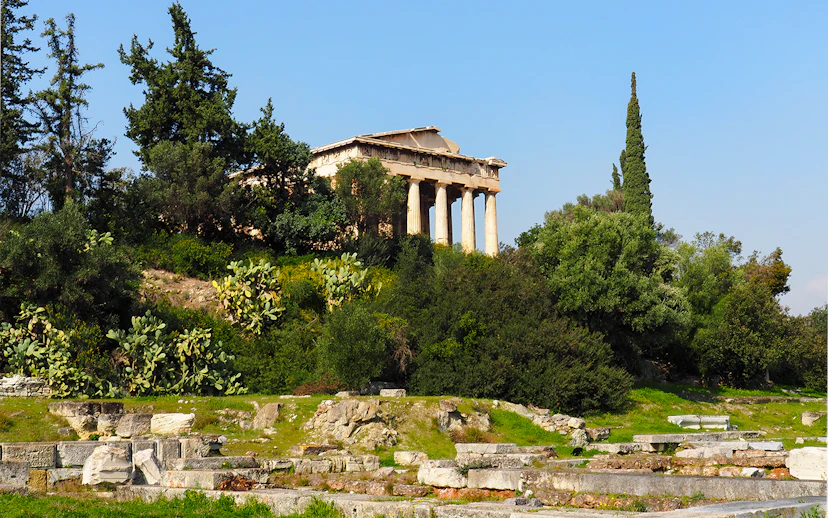
This is the most visually complete monument on the site, and for many visitors it’s the one structure that makes the whole visit feel immediately worth it. Slow down for the proportions and the views back across the Agora toward the Acropolis. What most people rush past is how different it feels from the lower ruins: it gives you a rare sense of whole architecture rather than foundations and fragments.
Where to find it: On the western rise above the archaeological field.
Stoa of Attalos
Era: Original 2nd century BC; reconstructed in the 1950s
The Stoa gives the Ancient Agora its most legible sense of scale and order. It’s also the place where the site stops feeling like scattered remains and starts reading as a functioning public space. Most visitors use it as a passageway, but the real payoff is standing in the long colonnade and noticing how the rebuilt structure clarifies the city’s commercial and civic rhythm.
Where to find it: Along the eastern edge of the site, beside the museum.
Museum of the Ancient Agora
Attribute — Collection focus: Finds from Neolithic to post-Byzantine Athens, with a strong democracy focus
If you only do one interpretive stop here, make it this one. The museum turns the Agora from ‘ruins with labels’ into a lived city through ostraka, everyday objects, and political artifacts. The detail most people underrate is that it’s compact enough to absorb in one pass without museum fatigue, which is why it works so well before the outdoor loop.
Where to find it: Inside the reconstructed Stoa of Attalos.
Panathenaic Way trace
Attribute — Historical role: Ceremonial and processional route through the Agora
This matters less as a photo stop than as a mental key to the site. Once you notice the route line and movement through the space, the Agora starts to read as a city in use rather than a field of isolated stones. Most visitors miss it because they’re looking for standing monuments, not circulation patterns.
Where to find it: Running through the central archaeological ground.
Democracy institutions cluster
Attribute — Historical role: Political, legal, and public-life zone
This is the part that explains why the Ancient Agora matters so much in Athens. The remains are less visually dramatic than the temple, but they are the site’s deepest reward if you care about civic history. Most people walk through too fast because the foundations look modest until the museum or an audio guide gives them context.
Where to find it: In the core archaeological field between the Stoa and the western rise.
Acropolis viewpoints from the Agora
Attribute — Viewpoint: Sacred hill seen from the city’s civic center
These sightlines are what connect the Agora and the Acropolis into one coherent Athens story. From here, you can read the contrast between ceremonial, sacred architecture above and practical public life below. Most people snap one quick photo and move on, but the better experience is to pause and take in the relationship between the two landscapes.
Where to find it: Best from the western side near the Temple of Hephaestus and open sightlines across the site.
Facilities and accessibility
- 🎟️ Museum access: Your site ticket already includes the Museum of the Ancient Agora, so treat it as part of the visit rather than an optional extra.
- 🚻 Restrooms: Accessible restrooms are available, and the museum zone is the most practical place to plan for them during your visit.
- 🛍️ Gift shop / merchandise: A museum shop operates in the Stoa area, and it’s the best place on-site for books and more useful historical guides than generic souvenirs.
- 🪑 Seating / rest areas: The Stoa colonnade and the greener parts of the site give you more breathing room than the Acropolis, which matters on hot days.
- ♿ Site support: Official visitor information also lists ramps, a lift, tactile material, and disabled WC, which makes the museum side the easiest services hub on arrival.
- ♿ Mobility: The museum is explicitly equipped with ramps, a lift, and accessible toilets, but the wider archaeological ground is uneven and only partly easy for wheelchairs or slower walkers.
- 👁️ Visual impairments: Official visitor information lists tactile material, and the museum is the best place to ask staff where to begin rather than heading straight into the open ruins.
- 🧠 Cognitive and sensory needs: This is usually a calmer, lower-stress heritage site than the Acropolis, and late afternoon tends to feel easiest if you prefer more space and less crowd pressure.
- 👨👩👧 Families and strollers: Strollers work best through the Stoa and museum route first, but the open archaeological terrain is not fully smooth from end to end.
The Ancient Agora works best for school-age children and curious younger visitors who like stories, space to move, and one strong monument rather than a dense indoor museum day.
- 🕐 Time: 60–90 minutes is realistic with young children, and the Temple of Hephaestus plus the museum are the easiest parts to prioritize.
- 🏠 Facilities: The museum zone is your most useful base for restrooms, shade, and a more structured stop if the outdoor ruins start to feel repetitive.
- 💡 Engagement: Frame the visit around ‘how a city worked’ — voting, trade, temples, and public life — because that lands better here than trying to name every ruin.
- 🎒 Logistics: Bring water, hats, and a light bag, and aim for late afternoon or shoulder-season mornings when the open ground is less punishing.
- 📍 After your visit: The pedestrian stretch around Thissio is the easiest nearby area for a snack break and a reset before moving on.
Rules and restrictions
What you need to know before you go
- Entry requirement: One valid Ancient Agora ticket covers both the archaeological site and the museum, while reduced or free-entry visitors should bring ID or eligibility proof.
- Bag policy: No official locker or bag-storage service surfaced in the current visitor information, so bring only what you’re prepared to carry across the site.
- Re-entry policy: Plan this as one continuous visit, because leaving for food or shade breaks means interrupting the route and dealing with entry again.
Not allowed
- 🖐️ Touching or climbing on the ancient remains is not allowed, and this rule matters here because so much of the site survives as low, fragile structural remains.
- 🐾 Pets: Service animals should follow the attraction’s accessibility rules, but the archaeological ground is not a good fit for a casual pet visit.
- 🚬 Smoking / vaping: Use outdoor common sense and avoid smoking around visitors, monuments, and museum areas.
Photography
Personal photography is generally the easiest fit here because the site is open-air and spread out. The distinction to watch is between the archaeological ground and any museum or exhibition areas where staff guidance may apply, especially around special displays or temporarily closed sections. Flash, tripods, and bulky filming setups are the kind of equipment most likely to draw restrictions, so keep it simple unless you’ve checked ahead.
Good to know
- The current entrance setup catches people out more often than crowds do, so don’t rely on older blog maps or pre-2025 walkthroughs.
- The biggest ‘upgrade’ here is usually interpretation, not speed — audio or a guide adds more value than paying a markup for line-skipping language.
Practical tips
- Book 1–3 days ahead in May–September if you want the simplest entry flow, but don’t treat this like the Acropolis — the bigger risk here is turning up at the wrong entrance or with no context, not missing out weeks in advance.
- Start with the museum, not the temple. The Stoa of Attalos gives the site its logic, and doing the outdoor loop first is what makes the center of the Agora feel like anonymous stone foundations.
- Late afternoon is usually the smartest time slot because the site feels calmer than the Acropolis by then, and the open ground is less punishing once the worst heat has eased.
- Bring a small bag, water, sunscreen, and shoes you trust on uneven ground. This is not a hard hike, but it is a broad archaeological site with irregular surfaces and long sun exposure in warmer months.
- Eat before you go or after you come out. There’s no surfaced official on-site café, so the best-value move is usually a pre-visit coffee or a post-visit meal in Thissio, Monastiraki, or Plaka rather than breaking your route midway.
- If you qualify for reduced or free entry, don’t pay an adult reseller rate out of convenience. The official concession rules can save real money, but only if you show up with the right proof.
What else is worth visiting nearby?
Commonly paired: Roman Agora of Athens
Roman Agora of Athens
Distance: 600 m — 8-min walk
Why people combine them: It’s the clearest compare-and-contrast pairing in central Athens — the Ancient Agora shows the civic core of classical Athens, while the Roman Agora shows how the city evolved later.
Book / Learn more
✨ Ancient Agora of Athens and Roman Agora of Athens are most commonly visited together — and simplest to do on a combo ticket. The combo keeps both marketplace stories in one walkable half-day and is cleaner than buying two separate self-guided products. → See combo options
Commonly paired: Acropolis of Athens
Acropolis of Athens
Distance: 1 km — 15-min walk
Why people combine them: Together, they tell the sacred-and-civic story of Athens better than either site does alone, and many visitors prefer the calmer Agora as the second half of the day.
Book / Learn more
Also nearby
Monastiraki Square
Distance: 700 m — 10-min walk
Worth knowing: It’s the easiest post-visit stop for food, people-watching, and resetting before another museum or archaeology site.
Kerameikos
Distance: 1 km — 15-min walk
Worth knowing: If you want one more archaeology-heavy stop without the Acropolis crowds, Kerameikos adds a different side of ancient Athens with tombs, city walls, and a quieter atmosphere.
Eat, shop and stay near Ancient Agora of Athens
- On-site: There is no surfaced official café inside the Ancient Agora, so food inside is more of a gap than a convenience.
- Efcharis (10-min walk, Adrianou 3, Athens): Traditional Greek taverna, mid-range, and a practical post-visit choice if you want to stay in the old-city core.
- Kuzina (10-min walk, Adrianou 9, Athens): Greek and Mediterranean, mid- to upper-mid-range, with a better sit-down feel if you want to turn the visit into a slower lunch.
- Little Kook (12-min walk, Karaiskaki 17, Athens): Café-dessert stop, mid-range, and useful if you want a lighter break rather than a full meal.
- Pro tip: Eat either before entry or right after you exit — the museum helps with understanding, but it does not solve hunger, and leaving halfway breaks the rhythm of the site.
- Museum shop at the Stoa of Attalos: Books, guides, and heritage-focused souvenirs, and the most worthwhile shopping if you want something tied directly to the site.
- Monastiraki Flea Market: General souvenirs, antiques-style browsing, and easy old-Athens atmosphere a short walk away if you want variety rather than museum merchandise.
- Adrianou Street shops: Standard tourist shopping close to the site, useful if you want a quick stop without making a separate shopping detour.
Yes — if your priority is walking to major sights, eating easily, and keeping logistics light, the wider Thissio–Monastiraki–Plaka area is a strong base. It’s busy and tourist-heavy, but that trade-off works well on short Athens stays when you want to move between the Ancient Agora, Roman Agora, and Acropolis without relying on transport. If you want a quieter or more local-feeling stay, this is less ideal.
- Price point: Central and convenience-driven, with rates that skew mid-range to high in the most walkable pockets.
- Best for: Short city breaks where you want early or late access to the historic center and minimal transport planning.
- Consider instead: Koukaki for a slightly calmer local feel near the Acropolis, or Syntagma if you want broader city access and easier transit connections beyond the old center.
Frequently asked questions about visiting Ancient Agora of Athens
Most visits take 1.5–3 hours. If you only want the highlights — mainly the Stoa, museum skim, and Temple of Hephaestus — 90 minutes is enough, but a fuller visit with the museum and the civic ruins usually lands closer to 2.5 hours.
No, you usually don’t need to book far in advance, but pre-booking is still useful in peak season. The Ancient Agora is generally easier to access than the Acropolis, so same-day entry is common, but booking ahead helps if you want a specific time window or a smoother start.
Usually not for speed alone. The Ancient Agora rarely has Acropolis-style queue pressure, so the better reason to pre-book is convenience or added audio context. If you’re paying extra, make sure you’re getting something beyond basic admission.
Arrive about 15–20 minutes early. That gives you enough buffer for finding the correct entrance during current works and sorting out tickets without rushing. The real time risk here is gate confusion, not a huge waiting line.
Yes, the Museum of the Ancient Agora is included in the standard site ticket. You do not need a separate museum add-on. That matters because the museum is what makes the ruins easier to understand, especially on a self-guided visit.
Yes, but keep it small. No official locker or bag-storage service surfaced in the current visitor information, so anything you bring is likely staying with you for the full visit. A light day bag is much easier than a full backpack on the uneven site.
Yes, personal photography is generally fine. The outdoor archaeological ground is the easiest place to shoot, while museum or exhibition areas may have tighter rules depending on the display. Keep gear simple unless you’ve checked ahead for anything more formal.
Yes, and this is one of the better Athens sites for small groups. The open layout is easier to move through than many museum interiors, and guided visits work especially well here because context adds so much. Just avoid squeezing it into an already overloaded same-day Acropolis schedule.
Yes, especially for school-age children who like space and stories more than long indoor museum time. The Temple of Hephaestus is the easiest visual anchor, and the museum adds enough structure to stop the site from feeling like random ruins. Aim for 60–90 minutes with younger children.
Partly, but not fully across the whole site. The museum has ramps, a lift, tactile material, and accessible restrooms, which makes the Stoa side the most accessible part of the visit. The wider archaeological ground is uneven and can still be challenging.
Food is easy nearby, but not inside the site itself. No official on-site café was surfaced in the current visitor information, so the practical plan is to eat before or after your visit in Thissio, Monastiraki, or Plaka, all of which are within a short walk.
Use the Thissio / Apostolou Pavlou side unless the official visitor notice says otherwise. Current works have changed how people enter, and older articles often send visitors to outdated gates. Check the latest access note before you set out.